
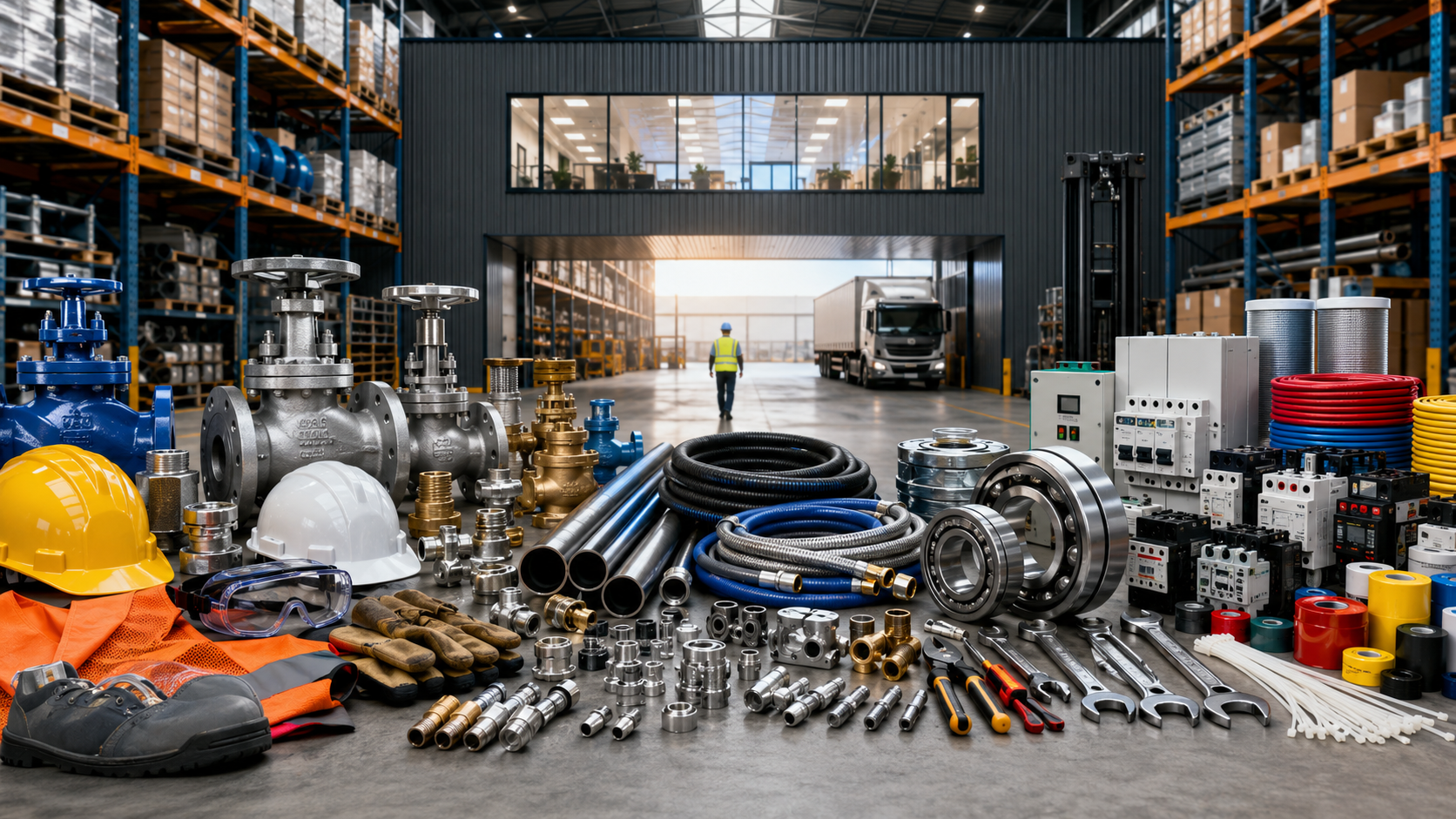
Single-source industrial supplier is a procurement model in which a company relies on one strategic supplier to provide a defined group of industrial products, materials, spare parts, consumables, MRO items, or operational supplies. Instead of managing many vendors for similar or related needs, the business centralizes purchasing with one qualified partner that can deliver consistency, technical support, traceability, and better control over supply.
For industrial companies in Mexico, the United States, and cross-border operations, this approach can simplify purchasing, reduce administrative workload, improve supplier accountability, and support more predictable operations. However, it also requires careful evaluation, strong service agreements, and a clear risk management plan.
In this guide, you will learn what a single-source industrial supplier is, how it works, when it makes sense, what benefits it offers, which risks to avoid, and how to choose the right supplier for your operation. More below, you will also find examples, warning signs, best practices, and a practical checklist for procurement teams.
What is a single-source industrial supplier?
A single-source industrial supplier is a supplier selected as the main or exclusive provider for a specific category of industrial needs. These may include safety equipment, tools, MRO supplies, adhesives, abrasives, fasteners, packaging materials, electrical components, cleaning products, maintenance parts, lubricants, or other operational inputs.
The term “single-source” does not always mean that the supplier is the only company capable of providing those products in the market. It means the buyer has intentionally chosen one supplier as its preferred source for a specific purchasing category.
This is different from a situation where only one supplier exists. In that case, the correct term is usually “sole-source supplier.” A single-source industrial supplier is chosen because it offers strategic value, not necessarily because there are no alternatives.
In practical terms, a company may decide to use a single-source industrial supplier to:
- Consolidate fragmented purchases.
- Reduce the number of purchase orders.
- Improve price negotiation.
- Standardize product quality.
- Gain faster response times.
- Improve inventory visibility.
- Strengthen supplier accountability.
- Simplify vendor management.
For example, a manufacturing plant may buy gloves from one vendor, abrasives from another, fasteners from another, cleaning supplies from another, and maintenance tools from yet another. A single-source industrial supplier can consolidate several of those categories under one purchasing relationship.
Single-source industrial supplier vs sole-source supplier
Although the terms are often confused, they do not mean the same thing.
A single-source industrial supplier is selected by choice. The buyer could purchase from other vendors, but chooses one preferred partner because it offers better service, pricing, logistics, technical knowledge, reliability, or category coverage.
A sole-source supplier exists because there is only one practical or approved source for a product, component, brand, certification, technology, or specification. The buyer has limited or no alternatives.
Single-source supplier
A single-source supplier is used when the buyer wants strategic consolidation. There may be other suppliers available, but the company decides to centralize purchasing with one partner.
This may happen because the supplier offers:
- Better commercial conditions.
- Broad product availability.
- Faster delivery.
- Technical support.
- Better reporting.
- Stronger logistics.
- More consistent service.
Sole-source supplier
A sole-source supplier is used when the buyer has no realistic alternative. This may occur with patented products, proprietary spare parts, specialized certifications, exclusive distribution agreements, or highly customized components.
For example, a machine may require an original replacement part from the manufacturer. If no equivalent is approved, the OEM becomes a sole-source supplier.
Understanding this difference matters because each model requires a different risk management strategy.
Why companies use a single-source industrial supplier
Industrial procurement often becomes complex as a company grows. More machines, more locations, more maintenance needs, and more departments usually mean more vendors, more invoices, more emergency purchases, and more administrative burden.
A single-source industrial supplier helps simplify that complexity.
Instead of treating every purchase as a separate transaction, the company builds a structured supply relationship with one partner capable of supporting its operational needs.
This model is common in industries such as:
- Manufacturing.
- Automotive.
- Aerospace.
- Food processing.
- Packaging.
- Metalworking.
- Construction.
- Energy.
- Mining.
- Logistics.
- Warehousing.
- Maintenance services.
- Industrial cleaning.
- Oil and gas support services.
In these environments, delays in supplies can stop production, increase downtime, affect safety, or create unnecessary costs.
A well-selected single-source industrial supplier can become part of the company’s operational stability.
How a single-source industrial supplier works
A single-source industrial supplier usually works through a structured purchasing agreement. The buyer and supplier define the product categories, service expectations, pricing conditions, delivery requirements, documentation standards, and communication process.
The relationship may include catalog agreements, blanket purchase orders, scheduled deliveries, consignment inventory, vendor-managed inventory, technical support, emergency supply protocols, or customized reporting.
The process usually includes several stages.
Supplier evaluation
The company first evaluates whether the supplier can meet its operational requirements. This includes product range, delivery capacity, certifications, quality controls, pricing, financial stability, service coverage, and experience in the relevant industry.
The evaluation should not focus only on price. In industrial procurement, the cheapest supplier is not always the best supplier.
Reliability, response time, product traceability, technical knowledge, and problem-solving capacity are often more important than a small price difference.
Category definition
The buyer defines which products or categories will be included in the single-source arrangement.
For example:
- Safety gloves and PPE.
- Industrial adhesives and tapes.
- Cutting tools.
- Janitorial and sanitation products.
- Electrical consumables.
- Packaging supplies.
- MRO materials.
- Lubricants and greases.
- Hardware and fasteners.
- Welding supplies.
A company does not need to move all purchases to one supplier at once. Many organizations begin with one category and expand gradually.
Commercial agreement
The buyer and supplier agree on pricing, payment terms, discounts, service levels, delivery conditions, minimum order values, emergency support, and escalation procedures.
This agreement should be clear enough to prevent confusion and flexible enough to adapt to real operational needs.
Product standardization
One of the biggest advantages of using a single-source industrial supplier is the ability to standardize products.
Instead of each department buying different brands, sizes, or specifications, the company can approve a controlled list of products.
This helps reduce waste, improve training, simplify inventory, and avoid unnecessary variation.
Ordering process
The company defines how orders will be placed. This may include email orders, online portals, ERP integration, recurring orders, scheduled deliveries, or purchase requisitions approved by department managers.
A clear ordering process reduces errors and improves internal control.
Delivery and logistics
The supplier must meet agreed delivery times and provide reliable logistics. Depending on the operation, deliveries may be daily, weekly, monthly, on demand, or based on inventory levels.
For plants with strict production schedules, delivery reliability is critical.
Performance review
The buyer should review supplier performance regularly. This includes fill rate, on-time delivery, product quality, responsiveness, invoice accuracy, cost savings, and issue resolution.
A single-source industrial supplier should be measured as a strategic partner, not just as a transactional vendor.
Main benefits of a single-source industrial supplier
Choosing a single-source industrial supplier can offer important advantages when the model is implemented correctly.
Simplified procurement
Managing dozens or hundreds of vendors creates administrative complexity. Each supplier may have different terms, invoices, delivery schedules, catalogs, contacts, and payment conditions.
A single-source industrial supplier simplifies the procurement process by reducing the number of active vendors and centralizing communication.
This can reduce:
- Purchase orders.
- Vendor onboarding tasks.
- Invoice processing.
- Administrative follow-up.
- Internal confusion.
- Repetitive negotiations.
- Duplicate purchases.
For procurement departments, this can free time for more strategic work.
Better supplier accountability
When purchases are divided among many vendors, it can be difficult to identify responsibility when problems occur.
With a single-source industrial supplier, accountability becomes clearer. The supplier knows it has a strategic role, and the buyer has a direct point of contact for issues, improvements, and performance reviews.
This can improve communication and make problem-solving faster.
More consistent product quality
Industrial operations depend on consistency. A small variation in tools, adhesives, protective equipment, packaging materials, or maintenance products can affect productivity, safety, or quality.
A single-source industrial supplier can help standardize approved products and reduce the use of inconsistent substitutes.
This is especially useful when plants need to comply with internal quality systems, safety protocols, or customer requirements.
Stronger purchasing power
Consolidating purchases with one supplier can increase purchasing volume. Higher volume may allow the buyer to negotiate better prices, rebates, delivery terms, payment conditions, or service levels.
The savings may not come only from unit price reductions. They can also come from lower administrative costs, fewer emergency purchases, reduced downtime, better inventory management, and fewer errors.
Improved inventory control
Fragmented purchasing often leads to excess inventory, duplicate items, obsolete stock, and poor visibility.
A single-source industrial supplier can support better inventory control through:
- Standardized catalogs.
- Consumption reports.
- Reorder points.
- Scheduled replenishment.
- Vendor-managed inventory.
- Stock level monitoring.
- Consolidated usage data.
This helps companies understand what they buy, how often they buy it, and where consumption can be optimized.
Faster response in urgent situations
Industrial operations often face urgent needs: a broken tool, a missing spare part, an unexpected maintenance task, or a safety supply shortage.
A strong single-source industrial supplier can provide faster support because it already understands the customer’s operation, approved products, delivery locations, and internal requirements.
This familiarity can reduce delays in critical moments.
Better technical support
A qualified industrial supplier does more than sell products. It can also help identify suitable alternatives, recommend equivalent materials, support product testing, explain specifications, and help standardize categories.
This is valuable when buyers need support from someone who understands industrial applications, not just catalog codes.
Reduced maverick spending
Maverick spending happens when employees buy outside approved purchasing channels. This can lead to higher prices, unapproved products, inconsistent quality, and poor expense control.
A single-source industrial supplier can reduce maverick spending by making the approved purchasing process easier, faster, and more reliable.
When users can get what they need through the right channel, they are less likely to buy outside the system.
Risks of using a single-source industrial supplier
A single-source industrial supplier can be highly valuable, but it also creates risks if the company becomes too dependent on one partner without proper controls.
Supplier dependency
The most obvious risk is dependency. If the supplier fails to deliver, increases prices unexpectedly, loses key inventory, or experiences operational problems, the buyer may be exposed.
This risk is especially important for critical materials, production inputs, safety supplies, or maintenance items that can stop operations.
Reduced competitive pressure
When a supplier knows it has a secure position, it may become less competitive over time. Prices may rise, service may decline, or innovation may slow down.
This does not always happen, but procurement teams should prevent it through performance reviews, benchmarks, and periodic market comparisons.
Supply disruption
A disruption in the supplier’s logistics, inventory, financial stability, labor capacity, or import process can affect the buyer directly.
Industrial companies should always understand where products come from, how long replenishment takes, and which items have higher risk.
Limited flexibility
One supplier may not be the best option for every category. Some highly specialized products may require niche suppliers with deeper technical expertise.
The single-source model should be applied where it makes sense, not as a rigid rule for all purchases.
Hidden cost increases
A supplier may offer attractive initial pricing but later increase costs through freight charges, minimum order requirements, substitutions, rush fees, or less favorable payment terms.
That is why total cost of ownership matters more than unit price alone.
How to reduce the risks of single-source industrial supply
The best approach is not to avoid single-source procurement entirely. The better approach is to manage it with clear rules.
Keep backup suppliers for critical items
Even when using a single-source industrial supplier, companies should identify backup suppliers for critical materials.
These backup suppliers may not receive regular purchase volume, but they should be prequalified in case of disruption.
Define service level agreements
A service level agreement should define what performance is expected. This may include delivery times, fill rate, product quality, response time, documentation, emergency support, and escalation process.
A verbal promise is not enough for critical industrial supply.
Review performance regularly
Supplier performance should be reviewed using measurable indicators. Useful KPIs include:
- On-time delivery rate.
- Order accuracy.
- Fill rate.
- Product defect rate.
- Response time.
- Invoice accuracy.
- Cost savings.
- Emergency order performance.
- Number of backorders.
- Corrective action response.
These indicators help the buyer manage the relationship objectively.
Benchmark prices
Even if the supplier is trusted, prices should be benchmarked periodically. This does not mean constantly threatening the supplier with competitors. It means maintaining market awareness.
Benchmarking protects the buyer and keeps the relationship commercially healthy.
Use category segmentation
Not every product should be treated the same way. A low-risk consumable is different from a critical production component.
The buyer should classify products by risk and impact:
- Critical items.
- High-value items.
- Frequently used consumables.
- Safety-related supplies.
- Emergency maintenance products.
- Non-critical office or janitorial materials.
This makes the single-source strategy more precise.
Maintain internal controls
Centralizing supply should not mean losing control. The buyer should maintain approved catalogs, authorization workflows, usage reports, and budget tracking.
A single-source industrial supplier works best when internal procurement discipline is strong.
When a single-source industrial supplier makes sense
A single-source industrial supplier is especially useful when the company wants to simplify procurement while maintaining reliable supply.
It usually makes sense when:
- The supplier has broad product coverage.
- The products are frequently purchased.
- The company has too many small vendors.
- Administrative costs are high.
- Product standardization is needed.
- Delivery reliability is important.
- The buyer wants better reporting.
- Internal users need faster service.
- There is a need to reduce emergency purchases.
- The supplier has proven technical knowledge.
For example, a manufacturing company may decide that all PPE, cleaning supplies, tapes, adhesives, and MRO consumables will be handled by one supplier. This can reduce complexity while still allowing specialized suppliers for critical machine parts.
When to avoid a single-source industrial supplier
A single-source industrial supplier may not be the best option in every situation.
It may be better to avoid or limit this model when:
- The supplier has weak financial stability.
- The product category is highly critical and difficult to replace.
- There are frequent stockouts.
- The supplier lacks technical expertise.
- Pricing is not transparent.
- Delivery times are inconsistent.
- The buyer has no backup plan.
- The supplier cannot provide documentation.
- Quality problems are frequent.
- The category requires specialized engineering support.
In these cases, a dual-source or multi-source strategy may be safer.
Single-source, dual-source, and multi-source procurement
To choose the right model, procurement teams should understand the difference between single-source, dual-source, and multi-source supply.
Single-source procurement
Single-source procurement means selecting one preferred supplier for a category. It provides simplicity, consistency, and stronger supplier accountability.
It works well for standardized products, recurring purchases, MRO supplies, PPE, tools, and categories where one supplier can provide reliable coverage.
Dual-source procurement
Dual-source procurement means using two approved suppliers for the same category. This reduces dependency while still keeping vendor management relatively simple.
It works well for critical items, high-volume materials, or products with supply risk.
Multi-source procurement
Multi-source procurement means using several suppliers. This can increase flexibility and competition but also creates more administrative complexity.
It works well when categories are highly specialized, market prices fluctuate, or no single supplier can cover the full need.
How to choose the right single-source industrial supplier
Selecting a single-source industrial supplier requires more than comparing prices. The supplier must be evaluated as a long-term operational partner.
Product range
The supplier should offer enough product coverage to justify consolidation. A broad catalog is useful, but relevance matters more than size.
Ask whether the supplier can provide the specific products your operation actually uses.
Industrial experience
A supplier that understands industrial environments can provide better support than a general distributor.
Look for experience with manufacturing plants, maintenance departments, safety teams, warehouses, production lines, field operations, or cross-border supply chains.
Availability and inventory
The supplier should have reliable access to inventory. This includes stocked products, lead times, replenishment capacity, and visibility into availability.
For recurring items, the supplier should be able to prevent frequent shortages.
Delivery capacity
Logistics matter. The supplier should be able to deliver to your facilities on time and handle urgent needs when required.
For companies operating in Mexico and the United States, cross-border logistics may also be important.
Technical knowledge
A strong single-source industrial supplier should understand specifications, equivalent products, safety requirements, and practical applications.
This is especially important for adhesives, lubricants, abrasives, tools, PPE, electrical supplies, and maintenance products.
Quality assurance
The supplier should provide consistent products and documentation when required. This may include certificates, data sheets, safety data sheets, compliance documents, lot traceability, or manufacturer information.
Pricing transparency
The supplier should offer clear pricing conditions. Buyers should understand unit prices, freight charges, minimum orders, discounts, payment terms, and possible price adjustments.
Customer service
Good customer service is essential. A supplier that does not answer quickly or resolve problems effectively can create operational friction.
Look for clear communication channels, assigned account support, escalation contacts, and proactive follow-up.
Digital capabilities
Many companies benefit from suppliers that offer digital tools such as online catalogs, order history, ERP integration, consumption reports, electronic invoicing, and spend analysis.
These tools can make purchasing more efficient.
Financial stability
A supplier selected as a single source must be stable enough to support the buyer over time. Financial weakness can create supply risk.
Scalability
The supplier should be able to grow with the customer. If the company opens new locations, adds production lines, or expands operations, the supplier should be able to support that growth.
Questions to ask before selecting a single-source industrial supplier
Before choosing a supplier, procurement teams should ask practical questions.
- What product categories can the supplier cover?
- Which items are stocked locally?
- What are the standard delivery times?
- Can the supplier support emergency orders?
- Does the supplier provide technical assistance?
- Can the supplier offer usage reports?
- Are prices fixed, indexed, or subject to change?
- What happens if a product is unavailable?
- Does the supplier offer approved alternatives?
- Can the supplier support multiple facilities?
- What documentation can be provided?
- Does the supplier have experience in our industry?
- What KPIs will be used to measure performance?
- Is there a clear escalation process?
- What backup plan exists for critical products?
These questions help determine whether the supplier is ready to become a strategic partner.
Practical examples of single-source industrial supplier use
A single-source industrial supplier can be applied in different industrial scenarios. The best examples show how the model works in real operations.
Manufacturing plant
A manufacturing plant uses multiple vendors for gloves, tapes, blades, cleaning products, adhesives, and maintenance tools. Each department buys separately, creating duplicate inventory and inconsistent product quality.
The company selects a single-source industrial supplier for MRO and consumable supplies. The supplier creates an approved catalog, standardizes products, schedules weekly deliveries, and provides monthly usage reports.
The result is better visibility, fewer emergency purchases, and simpler administration.
Automotive supplier
An automotive supplier needs consistent PPE, abrasives, fasteners, and shop supplies across several production lines.
By consolidating with one supplier, the company reduces product variation and improves compliance with internal safety and quality standards.
The supplier also helps identify equivalent products that reduce cost without affecting performance.
Food processing facility
A food processing plant requires cleaning supplies, PPE, sanitation products, maintenance consumables, and packaging-related items.
The company needs reliable documentation and consistent supply. A single-source industrial supplier helps maintain approved products, provide data sheets, and support recurring replenishment.
This improves control and reduces purchasing errors.
Warehouse operation
A logistics company uses industrial tape, stretch film, safety vests, gloves, labels, pallet supplies, and cleaning products.
Purchasing is fragmented across many small suppliers. By choosing one preferred industrial supplier, the company reduces order processing time and improves stock availability.
Maintenance department
A maintenance team frequently needs lubricants, tools, electrical consumables, fasteners, fittings, and replacement supplies.
A single-source industrial supplier creates a dedicated list of recurring maintenance items and supports urgent requests. This helps reduce downtime and makes maintenance planning easier.
Common mistakes when choosing a single-source industrial supplier
The single-source model can fail when it is implemented without enough analysis. In the section of errors below, you will see the most common problems and how to avoid them.
Choosing based only on price
Low prices are attractive, but industrial procurement is not only about unit cost. A cheap supplier that delivers late, sends wrong products, or lacks technical support can become expensive.
The correct question is not “Who is cheapest?” but “Which supplier offers the best total value?”
Not defining product categories clearly
If the company does not define what the supplier will cover, the relationship can become confusing.
A clear scope prevents misunderstandings and helps both sides measure performance.
Ignoring critical item risk
Some products are too important to depend on one supplier without backup. Critical spare parts, production materials, safety supplies, and long-lead-time items need special controls.
Failing to review performance
A single-source industrial supplier should not be selected and then forgotten. Performance must be reviewed regularly.
Without reviews, small problems can become normal.
Allowing too many substitutions
Substitutions can be useful when managed properly, but uncontrolled substitutions can create quality, safety, or compatibility problems.
Approved alternatives should be documented before they are used.
Not involving internal users
Procurement should involve maintenance, safety, production, warehouse, quality, and operations teams when selecting a supplier.
These users know which products work, which ones fail, and which service problems affect daily operations.
Having no exit strategy
Even a strong supplier relationship needs an exit plan. The buyer should know how to transition to another supplier if service declines or business conditions change.
Best practices for managing a single-source industrial supplier
A single-source industrial supplier relationship works best when both sides understand expectations.
Start with a pilot category
Instead of moving all industrial supplies to one supplier immediately, start with one or two categories. This allows the company to test service, pricing, communication, and delivery reliability.
Good pilot categories include PPE, MRO consumables, cleaning products, tools, or packaging supplies.
Create an approved product list
An approved product list helps standardize purchasing. It should include product descriptions, codes, brands, units of measure, approved alternatives, and internal users.
This reduces confusion and supports better inventory control.
Define KPIs from the beginning
Supplier performance should be measurable. The most useful KPIs include on-time delivery, fill rate, order accuracy, response time, invoice accuracy, and cost savings.
Schedule business reviews
Quarterly or semiannual reviews help keep the relationship healthy. These meetings can cover performance, pricing, consumption trends, service problems, improvement opportunities, and future needs.
Document approved alternatives
If a product is unavailable, the supplier should not send any substitute without approval. Alternatives should be reviewed by procurement, quality, safety, or maintenance teams as needed.
Use consumption data
A good supplier should help the buyer understand purchasing patterns. Consumption reports can reveal overuse, duplicate items, seasonal demand, or opportunities to standardize.
Keep communication simple
One of the main benefits of a single-source industrial supplier is simplified communication. The buyer should know who to contact for orders, emergencies, technical questions, billing, and escalations.
Review total cost of ownership
Total cost of ownership includes more than the purchase price. It also includes freight, downtime, defects, administrative time, inventory costs, emergency purchases, and product performance.
A supplier that reduces operational friction may create more value than one that offers a slightly lower unit price.
Signs that your single-source industrial supplier is working well
A single-source industrial supplier is working well when the relationship improves operational control, reduces friction, and supports business continuity.
Positive signs include:
- Orders arrive on time.
- Product quality is consistent.
- Internal users trust the supplier.
- Emergency requests are handled quickly.
- Inventory shortages decrease.
- Product substitutions are controlled.
- Pricing is transparent.
- Reports are useful.
- Communication is clear.
- Administrative workload decreases.
- The supplier proposes improvements.
- Procurement has better visibility.
- Complaints decline over time.
When these signs are present, the supplier is not just selling products. It is helping the company operate more efficiently.
Signs that your single-source industrial supplier is creating problems
The model may be failing if the supplier becomes a bottleneck instead of a solution.
Warning signs include:
- Frequent late deliveries.
- Repeated stockouts.
- Unexplained price increases.
- Poor communication.
- Lack of technical support.
- Incorrect products.
- Too many unauthorized substitutions.
- Invoice errors.
- No performance reporting.
- Slow response to complaints.
- Internal users buying outside the agreement.
- No backup plan for critical products.
When these signs appear, the company should review the agreement, escalate issues, and consider alternative sourcing strategies.
How to implement a single-source industrial supplier strategy
Implementing this model requires structure. A rushed transition can create confusion, resistance, and supply problems.
Map current spending
The first step is to understand current purchasing behavior. Review vendors, categories, annual spend, order frequency, emergency purchases, delivery issues, and product duplication.
This creates a baseline for improvement.
Identify consolidation opportunities
Look for categories with many vendors, repetitive purchases, similar products, or high administrative burden.
Good candidates include PPE, MRO supplies, tools, cleaning products, packaging materials, adhesives, tapes, and consumables.
Classify risk
Not every item should be consolidated in the same way. Classify products by operational importance, availability, lead time, safety impact, and replacement difficulty.
Critical items may require backup suppliers even if they are included in the main agreement.
Select potential suppliers
Create a shortlist of suppliers that can support the categories. Evaluate product range, technical expertise, logistics, pricing, documentation, and service capacity.
Run a pilot
Choose a limited category or location to test the supplier. Track delivery performance, communication, pricing accuracy, product acceptance, and internal user feedback.
Build an approved catalog
After the pilot, create a formal catalog of approved products. Include descriptions, part numbers, units of measure, pricing, alternatives, and delivery expectations.
Train internal users
Internal users must understand the new process. Explain how to place orders, what products are approved, who to contact, and why the change matters.
Measure results
Compare results against the original baseline. Look at cost, service, delivery, inventory, emergency purchases, and administrative workload.
Expand gradually
If the pilot works, expand to more categories, facilities, or departments. A gradual rollout reduces risk and improves adoption.
Product categories commonly managed by a single-source industrial supplier
A single-source industrial supplier can support many product categories, depending on its capabilities.
Common categories include:
- Personal protective equipment.
- Gloves, glasses, helmets, and respiratory protection.
- Hand tools and power tool accessories.
- Abrasives and cutting discs.
- Adhesives, sealants, and tapes.
- Fasteners and hardware.
- Cleaning and sanitation products.
- Lubricants, oils, and greases.
- Welding consumables.
- Electrical supplies.
- Packaging materials.
- Maintenance consumables.
- Janitorial supplies.
- Spill control products.
- Safety signage and facility supplies.
- Warehouse supplies.
- Material handling accessories.
The best categories to consolidate are those with recurring demand, standardized specifications, and measurable consumption.
What procurement teams should include in the agreement
A single-source industrial supplier agreement should be clear and practical. It does not need to be unnecessarily complex, but it should define the most important expectations.
Useful elements include:
- Product categories covered.
- Approved product list.
- Pricing structure.
- Payment terms.
- Delivery frequency.
- Lead times.
- Minimum order requirements.
- Emergency support.
- Service levels.
- Reporting requirements.
- Quality expectations.
- Documentation requirements.
- Substitution rules.
- Return process.
- Escalation contacts.
- Review frequency.
- Confidentiality requirements.
- Termination conditions.
- Backup supply provisions.
Clear agreements protect both the buyer and the supplier.
Single-source industrial supplier and supply chain resilience
Some companies assume that using one supplier automatically weakens supply chain resilience. That is not always true.
A poorly managed single-source model can increase risk. But a well-managed single-source industrial supplier can improve resilience by giving the company better visibility, stronger accountability, and faster communication.
The key is to avoid blind dependency.
A resilient strategy includes:
- Backup suppliers for critical items.
- Inventory buffers for high-risk products.
- Clear lead time visibility.
- Approved alternatives.
- Regular supplier reviews.
- Risk classification by category.
- Strong communication channels.
- Contingency plans.
The goal is not to depend blindly on one supplier. The goal is to centralize where it creates value and protect the operation where risk is high.
Single-source industrial supplier for cross-border operations
Companies operating between Mexico and the United States often face additional procurement challenges. These may include language differences, import processes, currency considerations, different product standards, logistics delays, and documentation requirements.
A single-source industrial supplier with cross-border experience can help simplify this complexity.
This is especially useful for companies with:
- Plants in Mexico and customers in the United States.
- Facilities on both sides of the border.
- Manufacturing operations near border regions.
- Export-oriented production.
- Shared procurement standards across countries.
- Bilingual purchasing teams.
- Need for consistent product specifications.
For cross-border operations, the supplier should understand delivery documentation, product equivalencies, lead times, and communication expectations in both markets.
How a single-source industrial supplier supports maintenance operations
Maintenance teams need fast access to reliable supplies. A missing fitting, tool, lubricant, fastener, or consumable can delay repairs and increase downtime.
A single-source industrial supplier can support maintenance by creating a dedicated catalog of frequently used items, maintaining stock of recurring products, and helping identify equivalent alternatives when needed.
This can improve:
- Preventive maintenance planning.
- Emergency repair response.
- Tool and consumable availability.
- Standardization across maintenance teams.
- Inventory control.
- Downtime reduction.
- Maintenance budget visibility.
For maintenance departments, the value of a supplier is often measured by availability and speed, not only by price.
How a single-source industrial supplier supports safety programs
Safety supplies must be consistent and available. If employees use different types of gloves, glasses, respirators, or protective equipment without control, safety risks may increase.
A single-source industrial supplier can support safety programs by helping standardize PPE, maintain stock, provide documentation, and reduce unauthorized substitutions.
Useful safety-related categories include:
- Gloves.
- Safety glasses.
- Helmets.
- Hearing protection.
- Respiratory protection.
- High-visibility apparel.
- Fall protection accessories.
- Spill control products.
- Lockout/tagout supplies.
- First aid supplies.
The supplier should understand that PPE is not just another product category. It directly affects worker protection and operational compliance.
How a single-source industrial supplier supports cost reduction
Cost reduction is one of the main reasons companies consider supplier consolidation. However, the most important savings often come from process improvements, not just lower prices.
A single-source industrial supplier can reduce costs by:
- Consolidating purchase volume.
- Reducing administrative workload.
- Lowering emergency purchase frequency.
- Improving inventory accuracy.
- Reducing duplicate products.
- Standardizing specifications.
- Decreasing product waste.
- Improving order accuracy.
- Reducing downtime caused by missing supplies.
- Supporting better consumption analysis.
For industrial buyers, the best supplier is not always the one with the lowest unit price. It is the one that helps reduce total operating cost.
How to measure success with a single-source industrial supplier
A single-source industrial supplier should be evaluated with clear metrics.
Useful measurements include:
- Annual spend by category.
- Number of active suppliers reduced.
- Purchase orders reduced.
- Invoice errors reduced.
- On-time delivery percentage.
- Order fill rate.
- Emergency purchases reduced.
- Inventory value reduction.
- Stockout frequency.
- Product standardization rate.
- Cost savings.
- Internal user satisfaction.
- Corrective action closure time.
- Response time to urgent requests.
These indicators show whether the model is improving procurement and operations.
Mini checklist for choosing a single-source industrial supplier
Use this checklist before selecting a single-source industrial supplier:
- Define the product categories to consolidate.
- Separate critical items from non-critical items.
- Review current spending and vendor count.
- Evaluate supplier product range.
- Confirm inventory availability.
- Check delivery capacity.
- Review technical knowledge.
- Ask for documentation capabilities.
- Compare total cost, not only unit price.
- Define approved products and alternatives.
- Establish service level expectations.
- Create KPIs.
- Keep backup suppliers for critical items.
- Run a pilot before full implementation.
- Train internal users.
- Schedule regular performance reviews.
- Maintain an exit plan.
This checklist helps avoid rushed decisions and supports a more reliable sourcing strategy.
Questions frequently asked by procurement teams
Procurement teams often ask whether the single-source model is too risky. The answer depends on category selection, supplier quality, and risk controls.
A single-source industrial supplier can be highly effective for recurring industrial supplies, MRO items, safety products, and operational consumables. It becomes risky when the buyer uses one supplier for critical products without backup alternatives.
Another common question is whether supplier consolidation always reduces costs. It can, but only when implemented correctly. Savings may come from price negotiation, but also from fewer invoices, fewer urgent purchases, better standardization, and lower administrative effort.
A third question is whether companies should use only one supplier for everything. Usually, no. The best approach is strategic segmentation. Use a single-source supplier where it adds value, and use dual-source or specialized suppliers where risk or complexity requires it.
FAQ
What is a Single-source industrial supplier?
A Single-source industrial supplier is a preferred supplier chosen to provide a specific group of industrial products or operational supplies. The buyer selects one main supplier to simplify purchasing, improve consistency, and strengthen supplier accountability.
Is a single-source supplier the same as a sole-source supplier?
No. A single-source supplier is chosen by strategy, even when other suppliers exist. A sole-source supplier is used because there is only one practical, approved, or available source for the product.
What are the main benefits of using one industrial supplier?
The main benefits are simplified purchasing, better product standardization, stronger supplier accountability, improved inventory control, lower administrative workload, and better purchasing visibility.
What is the biggest risk of single-source procurement?
The biggest risk is supplier dependency. If the supplier fails to deliver or service declines, the buyer may face delays, shortages, or higher costs. This risk can be reduced with backup suppliers and performance reviews.
When should a company avoid a single-source industrial supplier?
A company should avoid this model when the supplier is unreliable, the product is highly critical, there is no backup plan, quality issues are frequent, or the supplier lacks technical and logistical capacity.
Conclusion
A single-source industrial supplier can be a powerful procurement strategy for industrial companies that want to simplify purchasing, improve control, standardize products, and reduce administrative complexity. When implemented correctly, this model turns the supplier relationship into a strategic asset rather than a simple buying channel.
The key is to use the model with discipline. A company should define categories clearly, evaluate supplier capabilities, measure performance, control substitutions, and maintain backup options for critical items. The goal is not blind dependence on one supplier, but intelligent consolidation where it improves reliability, cost control, and operational efficiency.
For manufacturing plants, warehouses, maintenance departments, safety teams, and cross-border operations, the right single-source industrial supplier can support smoother operations, better visibility, and stronger procurement decisions over time.