
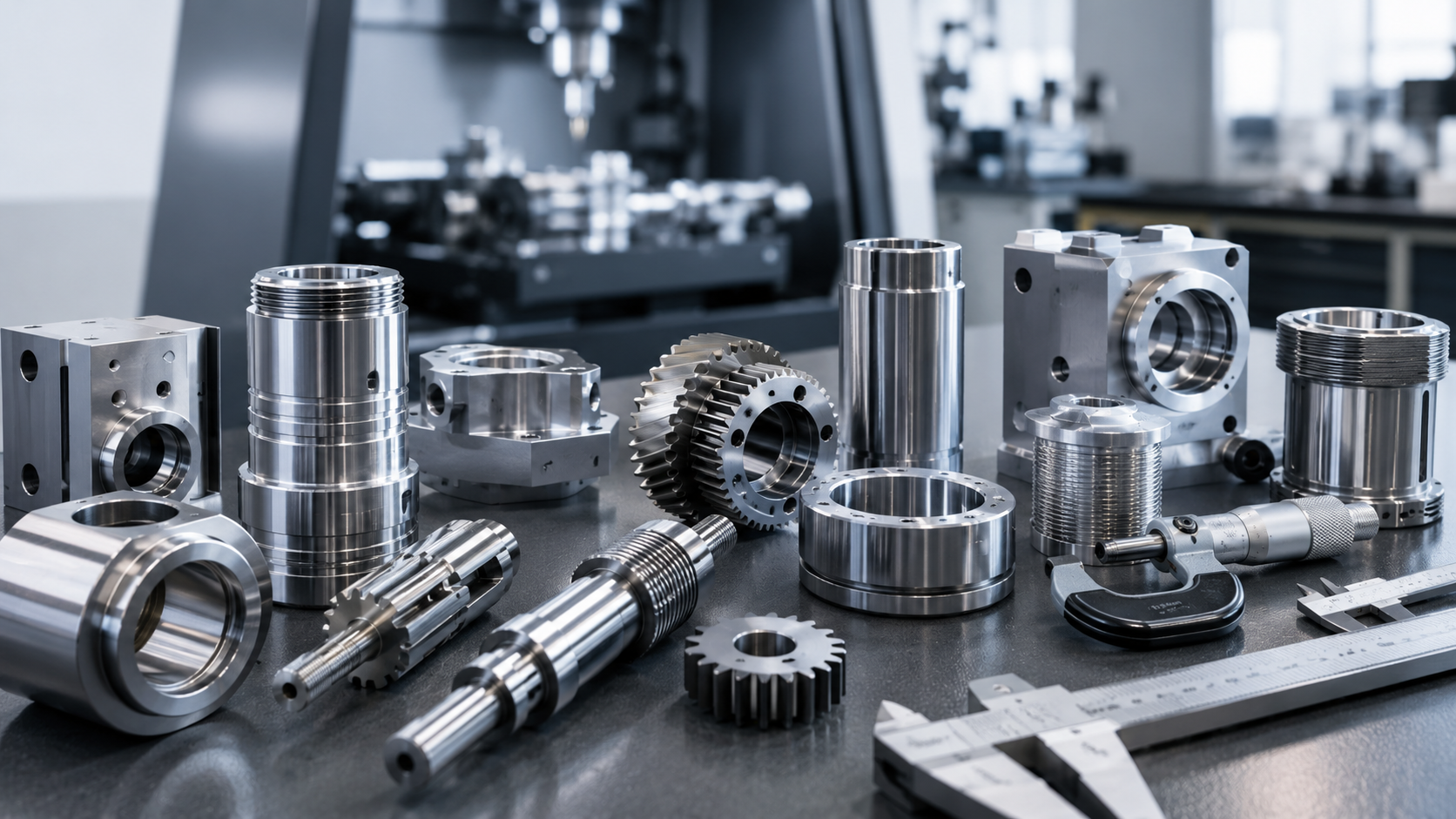
Precision machining components are custom or standardized parts manufactured with tight tolerances, controlled dimensions, and high surface-quality requirements for industrial applications. They are used when a part must fit, move, seal, support, align, or transmit force with a high degree of accuracy.
For manufacturers, maintenance teams, engineers, and purchasing departments, understanding these components is essential because the quality of a machined part can directly affect equipment performance, production uptime, safety, and total operating cost.
In this guide, you will learn what precision machining components are, how they are made, where they are used, what materials are common, how to evaluate quality, and how to choose the right supplier. More below, you will also find practical examples, common mistakes, and a quick checklist for requesting a quotation.
What Are Precision Machining Components?
Precision machining components are parts produced by removing material from a workpiece using controlled cutting processes. These parts are usually made from metals, plastics, or engineering alloys and are designed to meet specific dimensional, geometric, and functional requirements.
Unlike basic fabricated parts, precision machined parts often require:
- Tight tolerances
- Accurate geometry
- Smooth or controlled surface finishes
- Consistent repeatability
- Material traceability
- Reliable quality inspection
These components may look simple from the outside, but their performance depends on small details such as diameter, concentricity, flatness, thread quality, hardness, finish, and alignment.
A small dimensional error can cause vibration, leakage, premature wear, assembly failure, or production downtime. That is why precision machining is commonly used in industries where reliability matters.
Why Precision Machining Components Matter in Industry
Precision machining components are important because machines depend on accurate parts to operate correctly. When a component is manufactured with the right dimensions and material properties, the entire system becomes more stable, efficient, and predictable.
In industrial environments, these parts often support critical functions such as:
- Holding assemblies in position
- Transmitting rotational or linear motion
- Sealing fluids or gases
- Guiding moving elements
- Connecting structural parts
- Reducing friction or wear
- Supporting tooling and fixtures
A poorly made component may not fail immediately. In many cases, the problem appears later as vibration, overheating, misalignment, excessive noise, or accelerated damage to surrounding parts.
This is why industrial buyers should not evaluate machined components only by price. A low-cost part can become expensive if it causes rework, machine stoppage, scrap, or safety risks.
Common Types of Precision Machining Components
Precision machining components can vary widely depending on the industry and application. Some are simple, while others require complex geometries and multi-axis machining.
Common examples include:
- Shafts
- Bushings
- Spacers
- Pins
- Housings
- Couplings
- Flanges
- Valves
- Fittings
- Inserts
- Sleeves
- Manifolds
- Brackets
- Gears
- Tooling parts
- Custom adapters
- Bearing supports
- Machine repair parts
- Prototype components
- Replacement parts for industrial equipment
Some components are used in new equipment manufacturing, while others are produced for maintenance, repair, and operations. In the section on examples, you will see how these parts are used in real industrial scenarios.
How Precision Machining Components Are Made
Precision machining components are manufactured through controlled cutting operations. The goal is to transform raw material into a finished part that matches the drawing, 3D model, or sample provided by the customer.
The process usually includes several stages.
Reviewing the Drawing or Technical Requirement
The first step is understanding the part requirement. This may include a technical drawing, CAD file, physical sample, or description of the function.
A good machining supplier reviews:
- Dimensions
- Tolerances
- Material requirements
- Surface finish
- Threads
- Fits
- Heat treatment
- Coating or plating needs
- Critical dimensions
- Inspection requirements
This stage is important because many production problems begin with incomplete or unclear specifications.
Selecting the Right Material
The material must match the application. A component used in a corrosive environment may need stainless steel. A wear part may require hardened steel. A lightweight component may use aluminum.
Material selection affects:
- Strength
- Weight
- Corrosion resistance
- Machinability
- Cost
- Surface finish
- Heat resistance
- Wear behavior
Choosing the wrong material can cause failure even if the machining process is accurate.
Choosing the Machining Process
Different machining methods are used depending on the geometry of the part.
Common processes include:
- CNC turning
- CNC milling
- Drilling
- Boring
- Threading
- Grinding
- Reaming
- Tapping
- EDM machining
- Swiss machining
- Surface finishing
For cylindrical components such as shafts, pins, bushings, and spacers, CNC turning is often used. For complex shapes, pockets, slots, and flat surfaces, CNC milling is common.
Some precision machining components require more than one process to achieve the final geometry.
Setting Up the Machine
Once the process is defined, the machinist or programmer prepares the machine. This includes tooling, workholding, cutting parameters, and program verification.
Good setup is essential for consistency. If the part is not held correctly, the finished component may have dimensional errors, poor finish, or geometric distortion.
Workholding may involve:
- Chucks
- Vises
- Fixtures
- Collets
- Soft jaws
- Custom clamps
For repeat production, dedicated fixtures can improve accuracy and reduce cycle time.
Machining the Component
The machine removes material according to the programmed toolpaths or manual operations. During machining, the supplier must control cutting speed, feed rate, tool wear, coolant, vibration, and chip evacuation.
Even with CNC equipment, precision depends on many variables. Skilled technicians still play a major role in achieving consistent results.
Inspection and Quality Control
After machining, the component is inspected to confirm it meets the required specifications.
Inspection tools may include:
- Calipers
- Micrometers
- Bore gauges
- Height gauges
- Thread gauges
- Surface roughness testers
- Optical comparators
- Coordinate measuring machines
- Hardness testers
For critical parts, inspection reports may be required. These reports provide evidence that the precision machining components meet the agreed dimensions and tolerances.
Common Materials Used for Precision Machining Components
The right material depends on the operating conditions, mechanical load, environment, and budget. Below are some of the most common options.
Carbon Steel
Carbon steel is widely used for industrial components because it offers good strength, availability, and cost efficiency.
It is commonly used for:
- Shafts
- Pins
- Bushings
- Spacers
- Fixtures
- Structural machine parts
Carbon steel may require coating, painting, oiling, or plating if corrosion protection is needed.
Stainless Steel
Stainless steel is used when corrosion resistance is important. It is common in food processing, chemical processing, medical equipment, marine environments, and humid industrial settings.
Benefits include:
- Corrosion resistance
- Clean appearance
- Good strength
- Long service life
- Compatibility with sanitary environments
However, stainless steel can be more difficult and costly to machine than carbon steel.
Aluminum
Aluminum is lightweight, corrosion resistant, and easy to machine. It is often used when weight reduction matters or when high-speed machining is required.
Common applications include:
- Housings
- Plates
- Brackets
- Fixtures
- Covers
- Prototype parts
Aluminum precision machining components are popular in automation, aerospace, electronics, packaging equipment, and custom machinery.
Brass and Bronze
Brass and bronze are used for components that need good machinability, corrosion resistance, or low-friction properties.
Typical examples include:
- Bushings
- Bearings
- Fittings
- Valve components
- Wear plates
- Electrical connectors
Bronze is especially useful in applications involving sliding contact and wear resistance.
Engineering Plastics
Some precision machining components are made from plastics such as nylon, acetal, PTFE, UHMW, and PEEK.
Plastic machined parts can offer:
- Low weight
- Chemical resistance
- Electrical insulation
- Low friction
- Noise reduction
- Corrosion resistance
They are often used in conveyors, packaging machinery, food processing equipment, and automation systems.
Key Tolerances in Precision Machining
Tolerance defines how much variation is allowed from the nominal dimension. For example, a shaft may need to be manufactured within a very small dimensional range to fit correctly into a bearing or coupling.
Important tolerance concepts include:
- Linear dimensions
- Diameter tolerance
- Flatness
- Parallelism
- Perpendicularity
- Concentricity
- Runout
- Position tolerance
- Thread accuracy
- Surface finish
Tighter tolerances usually increase production cost because they require more control, slower machining, better tooling, and more inspection.
A common mistake is requesting unnecessarily tight tolerances for every dimension. A better approach is to define critical tolerances only where they affect function.
Surface Finish and Why It Matters
Surface finish refers to the texture or smoothness of a machined surface. It affects appearance, friction, sealing, wear, lubrication, and fatigue performance.
A rough surface may be acceptable for a non-critical bracket, but not for a sealing face, bearing surface, hydraulic component, or sliding mechanism.
Surface finish can affect:
- Friction between moving parts
- Ability to seal against leakage
- Paint or coating adhesion
- Fatigue resistance
- Wear rate
- Cleanability
- Visual quality
Different machining processes produce different finishes. Turning, milling, grinding, polishing, and lapping can all create different surface characteristics.
Industries That Use Precision Machining Components
Precision machining components are used across many sectors because industrial equipment depends on reliable mechanical parts.
Manufacturing and Automation
Manufacturing plants use machined components in conveyors, robotic systems, tooling, fixtures, guides, shafts, and machine frames.
These components help production lines maintain speed, alignment, and repeatability.
Oil, Gas, and Energy
In energy-related industries, machined parts may be used in pumps, valves, compressors, couplings, and specialized equipment.
The components often need to withstand pressure, heat, corrosion, and continuous operation.
Food and Beverage Processing
Food processing equipment requires parts that are easy to clean, corrosion resistant, and compatible with sanitary standards.
Stainless steel and approved engineering plastics are common choices.
Packaging Machinery
Packaging lines rely on guides, shafts, spacers, rollers, plates, and change parts that must fit accurately and withstand repeated movement.
Precision machining helps improve line efficiency and reduce jams or misalignment.
Automotive and Transportation
Precision machined parts are used in engines, transmissions, suspension systems, testing equipment, tooling, and assembly fixtures.
Consistency is especially important when components are produced in high volumes.
Aerospace and Defense
Aerospace applications often require strict tolerances, advanced materials, documentation, and traceability.
Components may need to meet demanding requirements for weight, strength, fatigue resistance, and reliability.
Medical and Laboratory Equipment
Precision parts are used in instruments, devices, fixtures, housings, and mechanical assemblies where accuracy and cleanliness are essential.
Materials and finishes must be selected carefully according to the application.
Practical Examples of Precision Machining Components
Precision machining components become easier to understand when viewed through real industrial uses.
Example: Replacement Shaft for Production Equipment
A manufacturing plant may need a replacement shaft for a machine that is no longer supported by the original manufacturer.
The supplier can reverse engineer the old shaft, identify the material, machine a new part, and verify critical dimensions such as diameter, keyway, thread, and bearing fit.
This avoids long downtime and helps extend the life of existing equipment.
Example: Custom Stainless Steel Fitting
A food processing facility may require a special stainless steel fitting for a fluid system.
The part must have accurate threads, smooth surfaces, and corrosion resistance. In this case, both material and finish are critical because the component may be exposed to cleaning agents and moisture.
Example: Aluminum Fixture for Assembly
An automation company may need a lightweight aluminum fixture to hold parts during assembly.
The fixture must be accurate enough to position the part repeatedly, but it may not require extremely tight tolerances on every surface. Smart tolerance planning keeps the component functional and cost-effective.
Example: Bronze Bushing for Moving Equipment
A maintenance team may need a bronze bushing for a piece of rotating or sliding equipment.
The bushing must have the correct inner diameter, outer diameter, length, and finish. If the fit is too loose, vibration may occur. If it is too tight, the assembly may overheat or seize.
Benefits of Using High-Quality Precision Machining Components
High-quality precision machining components offer several practical advantages.
Better Equipment Performance
Accurate components help machines run with less vibration, better alignment, and smoother motion.
This can improve productivity and reduce mechanical stress.
Reduced Downtime
Reliable parts reduce the risk of unexpected failure. For maintenance teams, this can be more valuable than the initial cost of the component.
Improved Assembly
Parts that meet the drawing fit correctly the first time. This reduces rework, delays, and installation problems.
Longer Service Life
Correct material, tolerance, and finish can increase component durability.
For example, a properly machined shaft with the right surface finish can improve bearing performance and reduce wear.
Greater Repeatability
In production environments, repeatability is essential. Precision machining allows the same component to be manufactured consistently across batches.
Better Total Cost Control
A cheaper component is not always the most economical option. A reliable part can reduce downtime, scrap, emergency repairs, and replacement frequency.
Common Mistakes When Buying Precision Machining Components
In the section of errors, you can identify issues that often increase cost, delay delivery, or reduce part performance.
Sending Incomplete Drawings
A supplier cannot accurately quote or manufacture a part if the drawing lacks dimensions, tolerances, material, finish, or quantity.
When possible, include:
- 2D drawing
- 3D model
- Material specification
- Quantity
- Finish requirement
- Critical dimensions
- Inspection needs
- Application details
Requesting Tight Tolerances Everywhere
Not every dimension needs to be extremely precise. Over-specifying tolerances increases cost without improving function.
A better approach is to identify which dimensions are critical and which can remain standard.
Choosing Material Only by Price
Material affects strength, corrosion resistance, wear, weight, and machinability. A low-cost material may fail quickly if it does not match the operating environment.
Ignoring Surface Finish
Surface finish is often treated as a minor detail, but it can be critical for sealing, movement, cleanliness, and durability.
Not Considering Lead Time
Precision machining components require programming, setup, material sourcing, machining, finishing, and inspection.
Urgent orders may be possible, but they usually require clear specifications and fast approval.
Selecting a Supplier Without Technical Capability
Not every machine shop has the same equipment, experience, inspection tools, or quality process.
For industrial buyers, supplier capability is as important as price.
How to Choose a Supplier for Precision Machining Components
Choosing the right supplier helps reduce risk and improve long-term results.
Evaluate Technical Experience
Look for a supplier that understands industrial applications, not just basic machining.
A good supplier can interpret drawings, ask useful questions, recommend materials, and identify potential manufacturing issues before production begins.
Review Equipment Capabilities
The supplier should have equipment suitable for your parts. This may include CNC lathes, CNC mills, grinding machines, inspection equipment, or specialized tooling.
The right machine depends on part size, geometry, tolerance, and production volume.
Ask About Quality Control
Quality control should be part of the process, not an afterthought.
Ask whether the supplier can provide:
- Dimensional inspection
- Material certificates
- First article inspection
- Batch inspection
- Surface finish verification
- Traceability
- Quality documentation
Check Communication Quality
A reliable supplier communicates clearly about feasibility, price, lead time, technical risks, and required information.
Poor communication can lead to mistakes even when the supplier has good machines.
Consider Production Volume
Some suppliers are better for prototypes and small batches. Others are better for repeat production or high-volume manufacturing.
Choose a partner that matches your purchasing pattern.
Look for Problem-Solving Ability
Industrial buyers often need more than a part. They need a solution.
A strong supplier can help with reverse engineering, material substitution, design for manufacturability, repair parts, and urgent maintenance needs.
Precision Machining Components for Maintenance and Repair
Many precision machining components are used in maintenance, repair, and operations. This is especially important when equipment is old, imported, discontinued, or difficult to service.
In these cases, a supplier may work from:
- A worn sample
- A broken component
- A sketch
- A partial drawing
- Equipment measurements
- Functional requirements
Reverse engineering must be done carefully because worn parts may not represent the original dimensions. The supplier may need to infer critical dimensions, identify fits, and check how the part interacts with surrounding components.
For maintenance teams, locally manufactured precision machining components can reduce dependency on long lead times and expensive imported replacements.
Precision Machining Components vs Fabricated Parts
Precision machining and fabrication are both important, but they are not the same.
Fabrication usually involves cutting, bending, welding, forming, and assembling metal structures. It is commonly used for frames, guards, tanks, platforms, and structural elements.
Precision machining focuses on removing material to create accurate dimensions and controlled surfaces.
Machining is usually preferred when the part requires:
- Tight fits
- Accurate holes
- Threads
- Bearing surfaces
- Sealing faces
- Roundness
- Flatness
- Repeatable geometry
Fabrication is often preferred for larger structures where extreme dimensional accuracy is not required on every feature.
Many industrial projects use both methods. For example, a welded frame may include precision-machined plates, shafts, bushings, or alignment blocks.
Custom vs Standard Precision Machining Components
Some components are standard and available from catalogs. Others must be custom manufactured.
When Standard Components Are Enough
Standard parts may be suitable when the application does not require unique geometry, special material, or unusual tolerances.
Examples include:
- Common screws
- Standard pins
- Off-the-shelf bushings
- Commercial spacers
- Standard fittings
- Catalog bearings
Standard components can reduce cost and delivery time.
When Custom Components Are Better
Custom precision machining components are better when the part must match a specific machine, process, or performance requirement.
Custom machining is useful for:
- Replacement parts
- Unique assemblies
- Special materials
- Non-standard dimensions
- Prototype development
- Equipment modifications
- Improved versions of existing parts
Custom manufacturing gives engineers and maintenance teams more control over fit, function, and durability.
Signs That Your Precision Machining Components Are Correct
You can often tell whether a component is well made by checking both documentation and performance.
Good signs include:
- The part matches the drawing
- Critical dimensions pass inspection
- Threads engage smoothly
- Surfaces are free from burrs
- Edges are properly finished
- The component assembles without force
- There is no unexpected vibration
- Wear is normal after operation
- Material documentation matches the requirement
- The supplier provides clear inspection results
A good component should not require excessive adjustment, filing, forcing, or modification during installation.
Signs That Something Is Wrong
A precision machined part may be problematic if you notice:
- Poor fit during assembly
- Misalignment
- Rough or damaged surfaces
- Burrs on edges or holes
- Threads that bind
- Excessive vibration
- Leaks after installation
- Premature wear
- Visible material defects
- Lack of inspection documentation
If the problem appears repeatedly, review the drawing, tolerance strategy, material choice, and supplier process.
Best Practices for Ordering Precision Machining Components
To get better results, provide clear information from the beginning.
Prepare Complete Technical Information
Include the drawing, material, finish, tolerances, quantity, and delivery requirements.
When possible, also explain the application. This helps the supplier understand which features are critical.
Identify Critical Dimensions
Mark the dimensions that directly affect function. This helps the supplier focus inspection and manufacturing control where it matters most.
Discuss Material Alternatives
Sometimes a supplier can recommend a material that is easier to machine, more available, or better suited to the application.
However, material changes should always be reviewed carefully for strength, corrosion resistance, wear, and compatibility.
Request Inspection Documentation When Needed
For critical parts, ask for inspection reports before shipment.
This is especially useful for components used in high-value equipment, safety-related assemblies, or production lines where downtime is expensive.
Start With a Prototype When Appropriate
For new designs, a prototype can reveal design issues before committing to larger production volumes.
Prototyping helps validate fit, function, assembly, and performance.
Build a Long-Term Supplier Relationship
A supplier who understands your equipment, standards, and recurring needs can become a valuable technical partner.
Over time, this can reduce quoting time, improve quality, and simplify repeat orders.
Mini Checklist for Requesting a Quote
Use this quick checklist before asking for a quotation for precision machining components:
- Do you have a 2D drawing or 3D model?
- Is the material clearly specified?
- Are critical tolerances identified?
- Is the quantity included?
- Is the surface finish defined?
- Are threads, holes, and fits clearly marked?
- Is heat treatment required?
- Is coating, plating, or anodizing needed?
- Do you need material certificates?
- Do you need inspection reports?
- Is the delivery date realistic?
- Have you explained the application if the part is critical?
This checklist helps reduce delays and avoids misunderstandings between engineering, purchasing, and the machining supplier.
When Precision Machining Components Are the Right Choice
Precision machining components are the right choice when accuracy, reliability, and repeatability are important.
They are especially useful when:
- The part must fit into an assembly
- The component interacts with bearings, seals, or shafts
- The machine requires alignment
- The application involves movement or load
- A replacement part is unavailable
- A custom design is required
- Standard parts do not meet the requirement
- Surface finish affects performance
They may not be necessary for simple structures, rough supports, or parts where dimensional accuracy is not critical. In those cases, fabrication or standard components may be more cost-effective.
Related Alternatives and When They Make Sense
Precision machining is powerful, but it is not always the only option.
Sheet Metal Fabrication
Sheet metal fabrication is useful for covers, panels, brackets, guards, and enclosures.
It is usually better when the part is made from thin metal and does not require complex machined features.
Casting
Casting can be useful for complex shapes and larger production volumes.
However, cast parts may still require machining on critical surfaces, holes, or mounting points.
Additive Manufacturing
Additive manufacturing, also known as 3D printing, is useful for prototypes, complex geometries, and lightweight structures.
For final industrial use, the material, strength, finish, and tolerance requirements must be carefully evaluated.
Standard Catalog Parts
Catalog components can save time and money when they meet the application requirements.
The key is knowing when a standard part is enough and when a custom machined component is necessary.
Questions to Ask Before Approving Production
Before approving production, ask these practical questions:
- Does the supplier fully understand the drawing?
- Are all critical dimensions clear?
- Is the selected material suitable for the operating environment?
- Are tolerances realistic and necessary?
- Is the surface finish defined?
- Are there any manufacturability concerns?
- Will inspection reports be provided?
- Is the lead time aligned with project needs?
- Are finishing or secondary operations included?
- Is packaging adequate to protect the parts?
These questions help prevent problems before the component reaches the production floor.
FAQ
What are precision machining components used for?
Precision machining components are used in machines, tools, fixtures, assemblies, and industrial equipment where accurate dimensions, reliable fit, and consistent performance are required.
What materials are best for precision machining components?
The best material depends on the application. Common options include carbon steel, stainless steel, aluminum, brass, bronze, and engineering plastics.
Are precision machined parts expensive?
They can cost more than basic parts because they require accurate machining, skilled setup, inspection, and quality control. However, they often reduce downtime and long-term operating costs.
What information is needed to quote a machined component?
A supplier usually needs a drawing or sample, material specification, dimensions, tolerances, quantity, surface finish, and any inspection or documentation requirements.
How do I know if a precision machining supplier is reliable?
A reliable supplier communicates clearly, reviews technical details, understands tolerances, uses proper inspection methods, and can provide consistent quality documentation when required.
Conclusion
Precision machining components are essential for industrial operations that depend on accuracy, durability, and repeatable performance. Whether the part is a shaft, bushing, fitting, housing, fixture, or custom replacement component, its quality can affect equipment reliability, assembly efficiency, and production uptime.
The best results come from combining clear technical specifications, suitable materials, realistic tolerances, proper machining processes, and strong quality control. Buyers should avoid choosing parts based only on price and instead evaluate function, supplier capability, documentation, and long-term cost.
When precision machining components are correctly designed and manufactured, they help machines run better, last longer, and perform with greater consistency. For industrial buyers, engineers, and maintenance teams, understanding these components is a practical advantage that supports better purchasing decisions and more reliable operations.